
Choosing the right eye hospital in Delhi is one of those decisions that deserves more thought than a quick Google search. Your eyes are not just organs, they are how you see your child’s face, read a book, navigate a busy road, and experience the world. When something feels off – blurry vision, a growing cataract, trouble seeing at night – you want to walk into a place where the doctor actually has time to listen, the technology is current, and the answer you get is honest.
This guide is not a promotional piece. It is written to help you make an informed decision, understand what to look for in a specialist depending on your condition, and know what questions to ask before you sit in a consultation chair.
Why Delhi Is One of the Best Places in India for Eye Care
Delhi is home to some of the most experienced ophthalmologists in the country. Between AIIMS, the government sector, and established private hospitals, the city has developed a dense cluster of eye care expertise over the past five decades. The challenge is not the absence of quality, it is the abundance of options, and knowing how to sort through them.
When patients come to Mohan Eye Institute, many tell us the same thing: “I visited two or three hospitals before coming here, and I wasn’t sure who to trust.” That is an honest and understandable feeling. Here’s how to simplify the decision.
The One Rule That Should Guide Your Search
Match your condition to a specialist, not just a hospital name.
A hospital may have an excellent cataract surgeon and an average retina team, or a world-class LASIK programme and limited experience in paediatric squint. The reputation of an institution is a useful starting point, but the subspecialist you see matters more than the sign outside the building.
Here is a condition-by-condition breakdown of what to look for.
Delhi Top Eye Hospital for Cataract Surgery (Motiyabind Operation)
Cataract surgery in Delhi has become remarkably safe and routine, but there is still meaningful variation in outcomes and most of it comes down to three things: the surgeon’s experience with phacoemulsification (stitchless, no-injection technique), the quality of the intraocular lens (IOL) chosen for your eye, and how well the hospital manages the pre-surgery assessment.
What to look for:
-
- Microincision phacoemulsification – not older techniques requiring stitches
-
- A proper biometry evaluation to calculate the exact lens power for your eye
-
- A range of premium IOL options – monofocal, toric (for astigmatism), trifocal (for spectacle independence after surgery)
-
- 24×7 post-operative support if something feels unusual
At Mohan Eye Institute, cataract surgery (White Motiyabind Operation) has been a core pillar of the practice since the institute was founded in 1980 by Dr. Hari Mohan – who was among the early practitioners of advanced phacoemulsification techniques in India. The institute now performs stitchless microincision cataract surgery with a comprehensive range of premium IOLs.
When to seek an urgent appointment: If your vision has become noticeably cloudier, you are experiencing significant glare while driving at night, or a previous examination flagged a “mature” or “hypermature” cataract, do not delay. Advanced cataracts are harder to remove safely.
Delhi Best Eye Hospital for LASIK Surgery (Specs Removal)
LASIK and its more advanced variants like Contoura Vision, SMILE, and bladeless Femto-LASIK have transformed how millions of people live. But the procedure is not one-size-fits-all, and the most important part of the process actually happens before the surgery: the screening.
A responsible eye care centre will tell you if you are not a good candidate for LASIK surgery. Thin corneas, dry eye syndrome, keratoconus, and certain prescription ranges require alternative approaches or disqualify surgery altogether. If a centre is eager to schedule your surgery before running thorough topography, pachymetry, and dry eye testing – walk away.
What to look for:
-
- A dedicated pre-LASIK screening process (usually 1.5–2 hours) before any surgical discussion
-
- Bladeless platforms – femtosecond laser for flap creation, excimer laser for correction
-
- Clear conversation about LASIK vs. ICL vs. SMILE vs. PRK based on your corneal profile
-
- Transparent discussion about dry eye risk, halos, and what “retreatment” means if your power shifts
Mohan Eye Institute offers bladeless LASIK with advanced laser vision correction. Importantly, the team follows a strict pre-surgical screening protocol; patients are evaluated for candidacy before a surgical plan is ever discussed.
A note on cost: LASIK surgery cost in Delhi can range from roughly ₹12,000 to ₹70,000+ per eye depending on the technology and eye care centre. The cheapest option is rarely the wisest for a permanent procedure on your cornea. Ask exactly which laser platform will be used on your eyes, not just a brand name in the brochure.
Delhi Eye Hospital for ICL Surgery
ICL (Implantable Collamer Lens) is the right choice for patients who are not suitable for LASIK; typically those with high prescriptions (above -8D or +4D), thin corneas, or significant dry eye. The lens is placed inside the eye in front of the natural lens without removing any corneal tissue. It can also be reversed, unlike LASIK.
What to look for:
-
- Surgeons specifically trained in phakic IOL implantation
-
- Pre-operative assessment of anterior chamber depth and endothelial cell count – these determine candidacy and safety
-
- Experience with both spherical and toric ICL (for astigmatism correction)
The team at MEI Delhi manages ICL surgery as part of its comprehensive refractive surgery programme, with proper candidate selection protocols.
Eye Care Hospital in Delhi for Retina Treatment
Retinal conditions – diabetic retinopathy, retinal detachment, macular degeneration, vitreous haemorrhage are among the most vision-threatening emergencies in ophthalmology. The difference between a good outcome and permanent vision loss can be measured in hours, not days.
What to look for:
-
- A dedicated vitreo-retinal surgeon (not a general ophthalmologist doing occasional retina)
-
- In-house OCT (Optical Coherence Tomography) and FFA (Fundus Fluorescein Angiography) – these are essential for accurate diagnosis
-
- 24×7 emergency access for sudden floaters, flashes of light, or a “curtain” across your vision these are signs of retinal detachment
-
- Experience with anti-VEGF injections for diabetic retinopathy and wet macular degeneration
Dr. Rajiv Mohan, a senior director at Mohan Eye Institute who trained in vitreo-retinal surgery at East Surrey Hospital in the UK, has a special interest in this area. The institute performs anti-VEGF injections, retinal laser treatments, and complex surgical procedures including vitrectomy.
Important: If you or a family member has diabetes, a retinal screening should happen every year regardless of whether vision feels normal. Diabetic retinopathy often causes no symptoms until it has already caused significant damage.
Eye Hospital in Delhi for Glaucoma Treatment
Glaucoma is called Black Motia / Black Motiyabind “the silent thief of sight” for a reason. In most cases, there is no pain, no obvious blurriness – just a slow, irreversible narrowing of the visual field. By the time most patients notice something is wrong, significant nerve damage has already occurred.
What to look for:
-
- Facilities for Humphrey Visual Field testing and OCT of the optic nerve – these are the primary tools for detecting and monitoring glaucoma
-
- A specialist who manages both medical treatment (eye drops) and surgical options (trabeculectomy, laser trabeculoplasty, minimally invasive glaucoma surgery)
-
- Continuity of care – glaucoma is a lifelong condition and requires a doctor you can return to over many years
Mohan Eye Institute has glaucoma management as a core subspecialty, with early diagnosis protocols and both medical and surgical treatment pathways.
Risk factors to know: If you are over 40, have a family history of glaucoma, have high myopia, or take long-term steroid medications – you should have an IOP (intraocular pressure) check and optic nerve assessment every one to two years, even without symptoms.
Eye Care Hospital in Delhi for Children’s Eye Care (Paediatric Ophthalmology)
Children’s eye problems are often missed precisely because children do not know what normal vision looks like. A child with amblyopia (lazy eye) may never complain – they simply adapt to seeing less from one eye. Squint (misaligned eyes) is often noticed by a parent before the child says anything.
What to look for:
-
- A dedicated paediatric ophthalmologist – not a general eye doctor who “also sees children”
-
- Equipment and an examination approach calibrated for children – this is different from adult examination
-
- Experience with cycloplegic refraction (accurate power testing in children requires dilating drops to relax accommodation)
-
- Facilities for patching therapy, vision therapy, and surgical correction of squint if required
Mohan Eye Institute has a dedicated paediatric ophthalmology and squint surgery department. The team manages comprehensive child eye examinations, lazy eye (amblyopia) therapy, and both functional and cosmetic squint correction.
When to bring your child for an eye check:
-
- Before age 3 for a developmental baseline
-
- Immediately if you notice one eye turning in or out
-
- If the child squints, sits very close to screens, rubs eyes frequently, or seems to have difficulty at school
-
- Every year through the school years – vision problems are a common but underappreciated cause of poor academic performance
Top Eye Hospital in Delhi for Myopia Treatment
Myopia (nearsightedness, or what most people call “number”) is at epidemic levels in Indian cities. Delhi’s combination of heavy academic pressure, indoor screen-heavy lifestyles, and reduced outdoor time is producing more young patients with rapidly progressing myopia than previous generations.
Beyond the inconvenience of spectacles, high myopia (above -6D) significantly increases the lifetime risk of retinal detachment, glaucoma, and cataract. This is why myopia management – not just correction, has become an important area.
What to look for:
-
- For children: ask about myopia control strategies (orthokeratology, atropine therapy, or specific spectacle lenses designed to slow progression)
-
- For adults: a thorough discussion of whether LASIK, SMILE, or ICL is most appropriate for your degree of myopia
-
- For high myopes: annual retinal examination regardless of whether you are planning surgery
Trusted Eye Hospital in Delhi for Squint
Squint surgery in adults and children requires a surgeon with specific training in strabismus – the measurement of ocular misalignment and the planning of precise muscle surgery. This is a subspecialty, and it is worth verifying the surgeon’s specific experience before proceeding.
Mohan Eye Institute’s paediatric and squint team handles both children and adult cases, including cosmetic squint correction – where adult patients seek to correct the appearance of misaligned eyes for social and professional reasons.
What Makes Mohan Eye Institute Different: A Transparent Look
Delhi offers a wide range of eye care options from government institutions like AIIMS and Guru Nanak Eye Centre to private hospitals across the city. While government eye hospitals provide accessible care, many patients look for shorter wait times, personalised attention, and advanced treatment options – which is where Mohan Eye Institute positions itself.
– AIIMS Delhi – Government, low cost, long wait
– Guru Nanak Eye Centre – Government, retina & cataract
– Mohan Eye Institute – Private, multi-specialty eye care
Clinical legacy that is actually documented: Mohan Eye Institute was founded in 1980 by Dr. Hari Mohan, a doctor whose career is remarkable by any measure. He was appointed Honorary Ophthalmic Surgeon to the President of India in 1968.
He was awarded the Padma Shri by President V.V. Giri in 1971 – one of India’s highest civilian honours.
He received the Dr. B.C. Roy National Award in 1995, presented by President Shankar Dayal Sharma – the most prestigious medical honour in India.
He was admitted as a Fellow of the Royal College of Physicians and Surgeons of Glasgow in 2002.
And in 2005, President APJ Abdul Kalam awarded him the Padma Bhushan – India’s third-highest civilian honour.
In 2008, he received an Honorary Doctorate from Sanjay Gandhi Postgraduate Institute of Medical Sciences. These are not awards given for marketing – they represent peer and governmental recognition of a genuinely distinguished career spanning six decades.
Read full list of awards and recognitions on the official page: https://mohaneyeinstitute.com/awards-and-recognition/
A family of trained specialists who have stayed:
Dr. Rajiv Mohan trained in vitreo-retinal surgery in the UK and has spent over three decades conducting free eye camps across Delhi, Haryana, Uttarakhand, and Himachal Pradesh.
He was awarded the Gold Medal by the Intraocular Implant and Refractive Society of India in 2006.
Dr. Sanjiv Mohan, a cornea, LASIK, and cataract specialist with FRCS (Glasgow), trained in Scotland and returned to build his career at the institute. This is a team that built the hospital and chose to stay.
Comprehensive subspecialties under one roof: Cataract, LASIK, ICL, retina, cornea, keratoconus, glaucoma, paediatric ophthalmology, squint, neuro-ophthalmology, thyroid eye disease, oculoplasty – the full spectrum is available across the Central Delhi, South Delhi, and Dwarka areas.
24×7 emergency access: Eye emergencies – trauma, sudden retinal detachment, chemical injuries cannot wait for morning appointments. Mohan Eye Institute maintains 24×7 emergency support with trauma-trained specialists.
Teaching institution: The institute is a postgraduate teaching centre, which means doctors are continuously evaluated and updated. Teaching hospitals generally maintain higher clinical standards than purely commercial practices because every case is subject to peer scrutiny.
The Questions You Should Always Ask Before Choosing an Eye Hospital
Before committing to any hospital or surgeon, ask these directly:
- Does the surgeon I am being scheduled with specifically subspecialise in my condition?
- Which laser platform or surgical technique will be used and why is that the right one for my case?
- What happens if I have a complication or my vision is not what was expected after surgery?
- Can I speak to the doctor directly before the day of surgery, or will I only see them on the table?
- What does my post-operative care look like, how many follow-up visits are included?
A hospital that answers these questions clearly and without rushing you is a hospital that respects your decision-making process.
How to Book an Appointment with Delhi Leading Eye Hospital
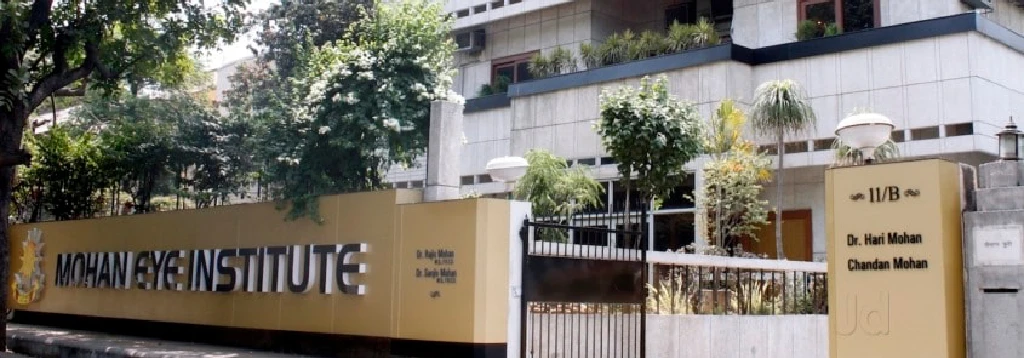
Mohan Eye Institute has multiple locations in Delhi NCR:
-
- Central Delhi (Main Campus)
11-B, Gangaram Hospital Marg, New Delhi – 110060
011-26787655, 25852048, 45666222
- Central Delhi (Main Campus)
-
- South Delhi
Aashlok Hospital, 25AB Community Centre, Safdarjung Enclave, New Delhi – 110029
011-46035433, 45035433
- South Delhi
-
- Dwarka
Venkateshwar Hospital, Sector 18A, Dwarka, New Delhi – 110075
011-48555555 (Extn 2918), 28083686/87/88
- Dwarka
-
- Bareilly
179, Civil Lines, Station Road, Opposite Hotel Pancham, Bareilly, Uttar Pradesh
0581-2510179, 2510269
- Bareilly
Walk-ins are accepted, but booking in advance reduces waiting time and ensures you are scheduled with the appropriate subspecialist for your condition.
Frequently Asked Questions
Which eye hospital in Delhi is good for cataract surgery?
Yes. The institute has performed cataract surgery for over four decades using stitchless microincision phacoemulsification with premium IOL options. Dr. Hari Mohan was among the early adopters of modern phacoemulsification in India.
Which Eye Hospital in Delhi is Good for Cataract Surgery?
Delhi has several well-established eye hospitals offering cataract surgery, each with experienced specialists and modern technology. When choosing an eye hospital, patients typically look for factors like surgeon experience, surgical technique, available lens options, and post-operative care.
Mohan Eye Institute is one of the renowned eye care centres in Delhi, with over four decades of experience in cataract surgery.
Which is the best hospital in Delhi for LASIK?
Several hospitals in Delhi offer quality LASIK. What matters most is pre-surgical screening and candidacy assessment, not just which hospital has the most billboards. Mohan Eye Institute uses bladeless LASIK with strict screening protocols to ensure surgery is performed only on appropriate candidates.
Which is a Good Eye Hospital Near Dwarka, Delhi?
Dwarka has access to several eye hospitals offering eye care services, including both general hospitals and specialised centres. When choosing an eye hospital, patients usually consider factors such as accessibility, doctor availability, treatment options, and overall patient experience.
Mohan Eye Institute offers eye care services in Dwarka through its presence at Venkateshwar Hospital, Sector 18A, Dwarka, New Delhi – 110075, which is well-connected to nearby residential sectors and metro stations.
This article is for informational purposes. Eye conditions should be diagnosed and treated by a qualified ophthalmologist. If you are experiencing sudden vision loss, flashes, floaters, or eye pain, please seek emergency care immediately.